Guide
How to Build a Habit in 21 Days: The Science (2026)
By Habit Tracker Spot · Updated 2026-03-20
Building a habit in 21 days is one of the most popular self-improvement claims — but neuroscience tells a more nuanced story. Research from University College London suggests the real average is closer to 66 days, though simple habits can form in as few as 18. Here is the evidence-based approach that actually works.
By Rachel Torres, Behavioral Science Writer | Last updated: March 2026
| Option | Best For | Price Range | Rating |
|---|---|---|---|
| Habitica | Gamification lovers | Free (Premium $4.99/mo) | ⭐⭐⭐⭐½ |
| Streaks App | Apple ecosystem users | $4.99 one-time | ⭐⭐⭐⭐⭐ |
| Clever Fox Habit Journal | Pen-and-paper people | $24.99 | ⭐⭐⭐⭐½ |
| Notion Habit Dashboard | Customization enthusiasts | Free (Plus $8/mo) | ⭐⭐⭐⭐ |
| Loop Habit Tracker | Android users wanting simplicity | Free | ⭐⭐⭐⭐⭐ |
Visual guide: The 21-day habit kickstart plan broken down week by week
Table of Contents
- The Origin of the 21-Day Myth
- What Neuroscience Actually Says About Habit Formation
- The Habit Loop: Cue, Routine, Reward
- Your 21-Day Kickstart Plan
- Week 1: The Initiation Phase (Days 1–7)
- Week 2: The Resistance Phase (Days 8–14)
- Week 3: The Consolidation Phase (Days 15–21)
- 5 Science-Backed Strategies to Strengthen Your Habit
- Best Habit Tracking Tools for 2026
- Common Mistakes That Derail Habit Formation
- What Happens After Day 21
- Sources & Methodology
- Frequently Asked Questions
The Origin of the 21-Day Myth
The idea that habits take exactly 21 days to form has been repeated so often it feels like settled science. But where did the number actually come from?
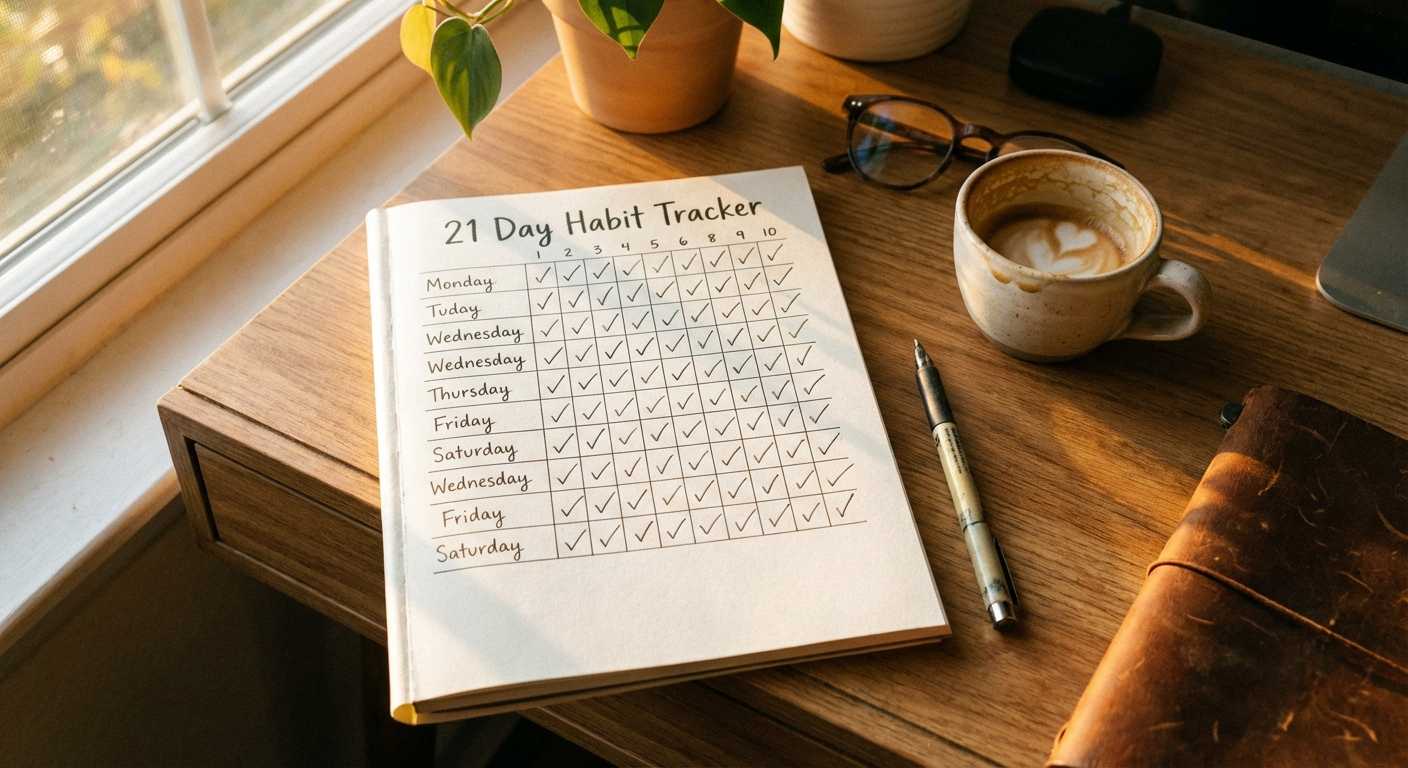
In his 1960 book Psycho-Cybernetics, plastic surgeon Dr. Maxwell Maltz observed that his patients took a minimum of about 21 days to adjust to their new appearance after surgery. He noticed similar patterns in his own behavior — it took roughly three weeks to form a new mental image. Maltz wrote: "These, and many other commonly observed phenomena, tend to show that it requires a minimum of about 21 days for an old mental image to dissolve and a new one to jell."
The critical word here is minimum. Somewhere between the original observation and its repetition across thousands of self-help books, "a minimum of 21 days" became "it takes 21 days." The nuance was lost, and a myth was born.
This matters because when people expect a habit to feel automatic by day 22 and it does not, they assume something is wrong with them rather than with the timeline they were given.
What Neuroscience Actually Says About Habit Formation
The most rigorous study on habit formation timelines comes from Dr. Phillippa Lally and her team at University College London. Published in the European Journal of Social Psychology in 2009, the study tracked 96 participants as they attempted to build a new daily habit over 12 weeks.
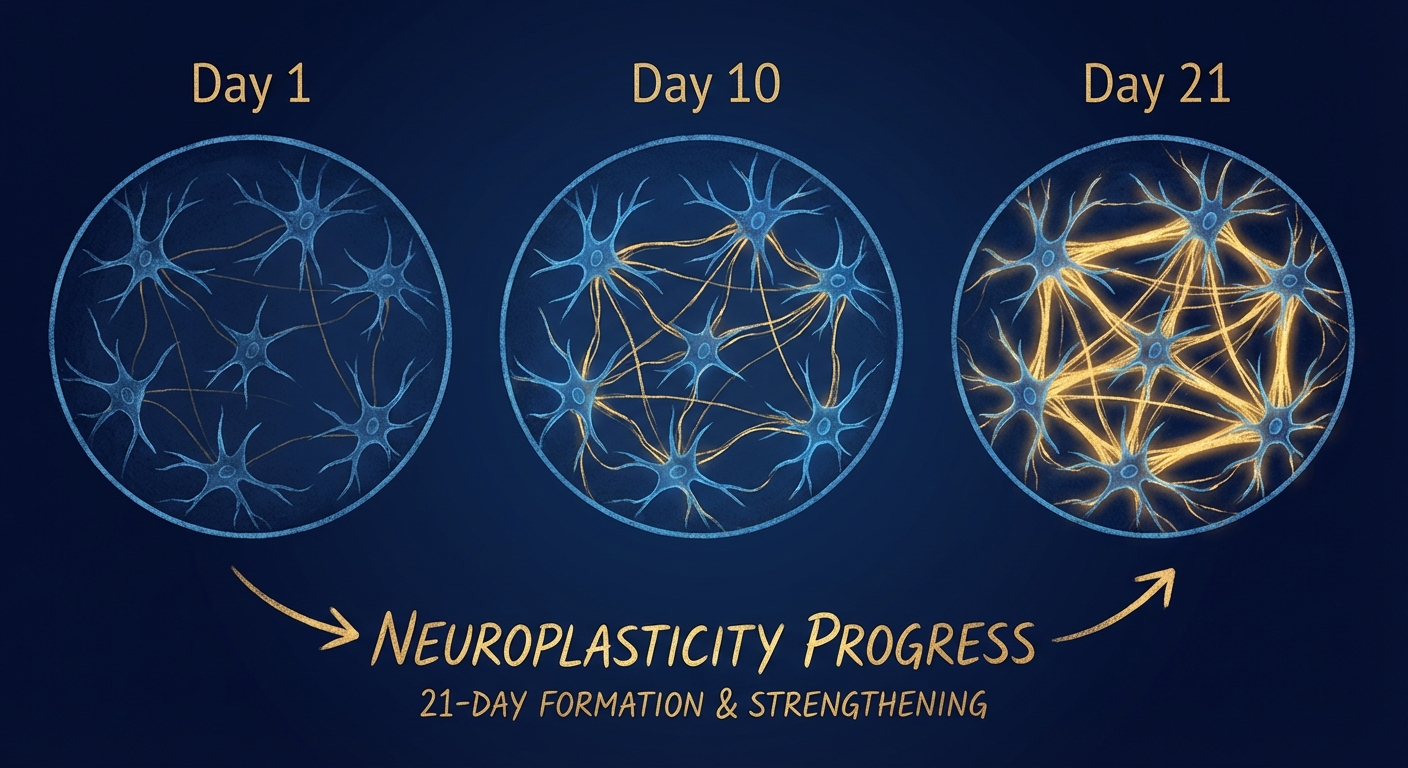
The findings were illuminating:
- Average time to automaticity: 66 days
- Fastest habit formed: 18 days (drinking a glass of water after breakfast)
- Slowest habit formed: 254 days (50 sit-ups after morning coffee)
- The range: Individual results varied enormously depending on the person and the complexity of the behavior
What does this mean for the 21-day framework? It is not useless — it is just incomplete. Twenty-one days is enough time to build the foundation of a habit, to establish the neural pathways and behavioral patterns that, with continued repetition, will eventually become automatic. Think of it as laying the concrete rather than building the entire house.
The Brain Science Behind Automaticity
When you first perform a new behavior, your prefrontal cortex — the brain's executive control center — works overtime. Every repetition requires conscious effort and deliberate decision-making. This is why new habits feel exhausting.
With repetition, something remarkable happens. Activity gradually shifts from the prefrontal cortex to the basal ganglia, a cluster of structures deep in the brain associated with automatic behavior and pattern recognition. This process, called "chunking," is how the brain converts a sequence of conscious actions into a single automatic routine.
Neuroscientist Ann Graybiel's research at MIT demonstrated that as habits form, the brain's activity at the beginning and end of a routine spikes (responding to the cue and the reward), while activity during the routine itself drops. The behavior has been chunked — packaged into an automatic unit that requires minimal conscious processing.
This is why you can drive to work without thinking about every turn, or tie your shoes while holding a conversation. The habit loop has been encoded.
The Habit Loop: Cue, Routine, Reward
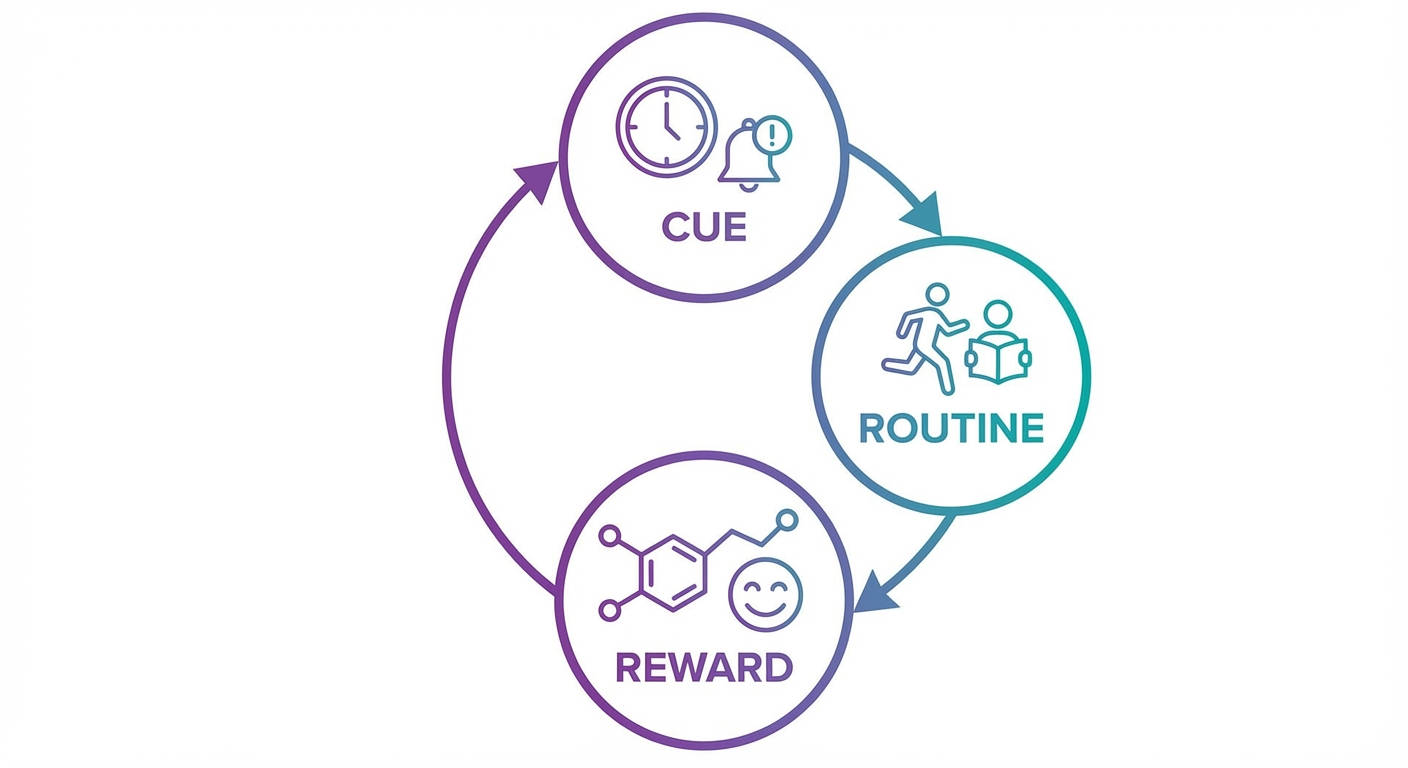
Every habit follows the same neurological pattern, first described by researchers at MIT and later popularized by Charles Duhigg in The Power of Habit. Understanding this loop is essential for deliberately building new behaviors.

Cue: The trigger that initiates the behavior. This can be a time of day, a location, an emotional state, a preceding action, or the presence of other people. The more specific and consistent your cue, the faster the habit forms.
Routine: The behavior itself — the action you want to turn into a habit. During the formation phase, this should be as simple as possible. Complexity is the enemy of consistency.
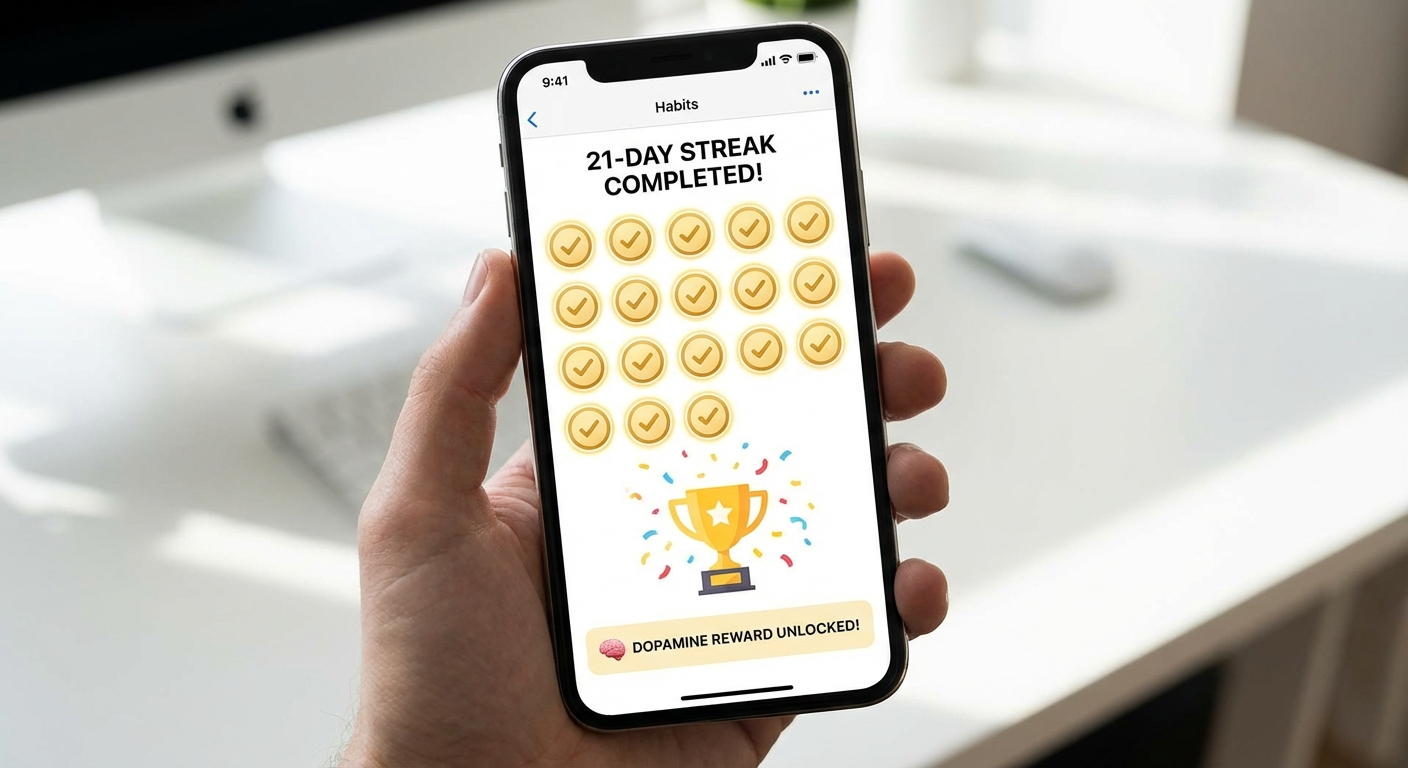
Reward: The positive reinforcement that tells your brain this loop is worth remembering. Rewards can be intrinsic (the satisfaction of completing a workout) or extrinsic (checking off a habit tracker). Dopamine, the brain's reward neurotransmitter, plays a central role here.
Here is the fascinating part: as a habit strengthens, dopamine release shifts from the reward to the cue. Your brain starts anticipating the reward the moment it encounters the trigger, creating a craving that drives the routine. This is the neurological signature of a formed habit.
Your 21-Day Kickstart Plan
While 21 days may not create a fully automatic habit, it is an excellent foundation-building period. Research supports breaking the first 21 days into three distinct phases, each with its own psychological challenges and strategies.
Before you start, choose one habit. Just one. A study published in the Journal of Consumer Research found that pursuing multiple new habits simultaneously reduced success rates by over 50 percent.
Week 1: The Initiation Phase (Days 1–7)
The first week is about establishing the cue-routine-reward loop and making the behavior as frictionless as possible.
Day 1–2: Set your implementation intention. Research by psychologist Peter Gollwitzer shows that "implementation intentions" — specific if-then plans — increase follow-through rates by 2x to 3x compared to general goal-setting. Instead of "I will meditate more," write: "After I pour my morning coffee, I will sit at the kitchen table and meditate for two minutes."
Day 3–4: Apply the 2-minute rule. Scale your habit down to something that takes less than two minutes. This concept, popularized by James Clear, leverages a simple truth: you cannot optimize a habit you have not started. Two minutes of meditation beats zero minutes every time.
Day 5–7: Design your environment. Dr. Wendy Wood's research at the University of Southern California demonstrates that environment design is more powerful than willpower for behavior change. Remove friction from your desired habit (lay out workout clothes the night before) and add friction to competing behaviors (put your phone in another room during your reading time).
What to expect this week: High motivation, moderate effort. The novelty of the new behavior provides its own reward. Enjoy this — it will not last.
Week 2: The Resistance Phase (Days 8–14)
This is where most people quit. The novelty has worn off, motivation dips, and the prefrontal cortex is still doing most of the heavy lifting. Research suggests the period between days 8 and 14 is the highest-risk window for habit abandonment.
Day 8–10: Expect the dip and plan for it. Psychologist Gabriele Oettingen's WOOP method (Wish, Outcome, Obstacle, Plan) has been validated across multiple studies. Identify your likely obstacles in advance and create specific if-then plans: "If I feel too tired to exercise, then I will do five minutes of stretching instead."
Day 11–12: Leverage accountability. A study from the American Society of Training and Development found that having an accountability partner increases the probability of completing a goal to 95 percent. Tell someone about your habit. Better yet, do it with someone.
Day 13–14: Never miss twice. Lally's research found that missing a single day did not significantly impact habit formation. But missing two consecutive days is where habits start to unravel. Make "never miss twice" your non-negotiable rule. If you miss Monday, Tuesday is sacred.
What to expect this week: Lower motivation, higher friction, self-doubt. This is normal. The neural pathways are being built — you just cannot feel it yet. If you are tracking your daily habits, this is where seeing your streak becomes a powerful motivator.
Week 3: The Consolidation Phase (Days 15–21)
By week three, something shifts. The behavior requires less conscious effort. You may notice that forgetting your habit feels uncomfortable — a sign that the basal ganglia is starting to take over.
Day 15–17: Begin scaling. If you have been meditating for two minutes, try five. If you have been reading one page, try five pages. Increase the intensity gradually — research on "shaping" from behavioral psychology shows that incremental increases maintain motivation while building capability.
Day 18–19: Stack your habit. Habit stacking — attaching a new behavior to an established one — leverages existing neural pathways. Behavioral scientist BJ Fogg's research at Stanford demonstrates that existing habits are the most reliable cues for new behaviors. "After I [existing habit], I will [new habit]" is the formula. If you are building a morning habit, our morning routine guide provides a complete framework for stacking habits into an effective start to your day.
Day 20–21: Reflect and recommit. Journal about what has changed. Research on self-monitoring shows that reflection strengthens the intention-behavior link. Note what is working, what is not, and what you will adjust for the next 45 days of consolidation.
What to expect this week: Reduced friction, emerging automaticity, occasional setbacks. The foundation is laid. Now you need to maintain and build on it.
5 Science-Backed Strategies to Strengthen Your Habit
These strategies are supported by peer-reviewed research and can be applied across all three phases of your 21-day kickstart.
1. Temptation Bundling
Developed by behavioral economist Katherine Milkman at Wharton, temptation bundling pairs a behavior you need to do with one you want to do. Listen to your favorite podcast only while exercising. Watch your guilty-pleasure show only while meal prepping. Milkman's research found this increased gym attendance by 51 percent.
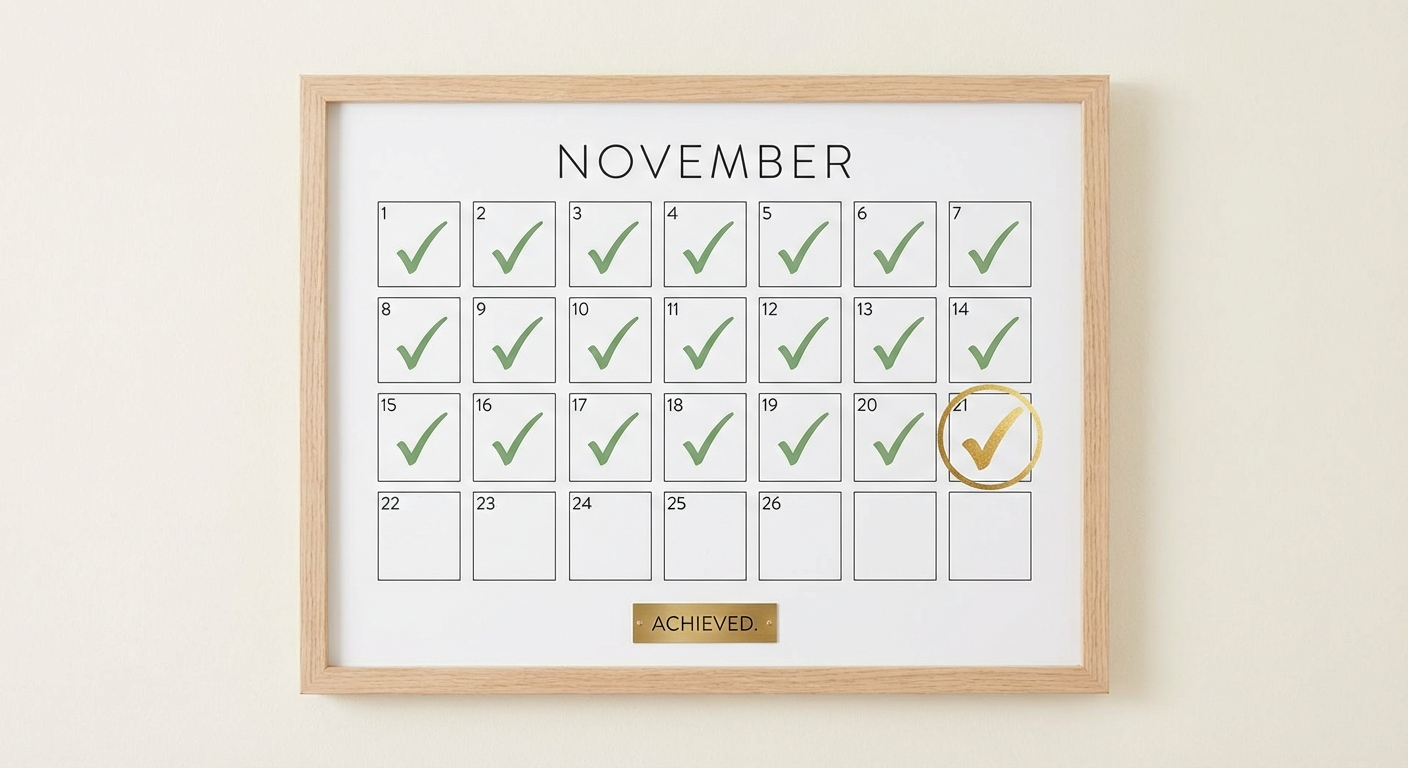
2. Visual Cues and Tracking
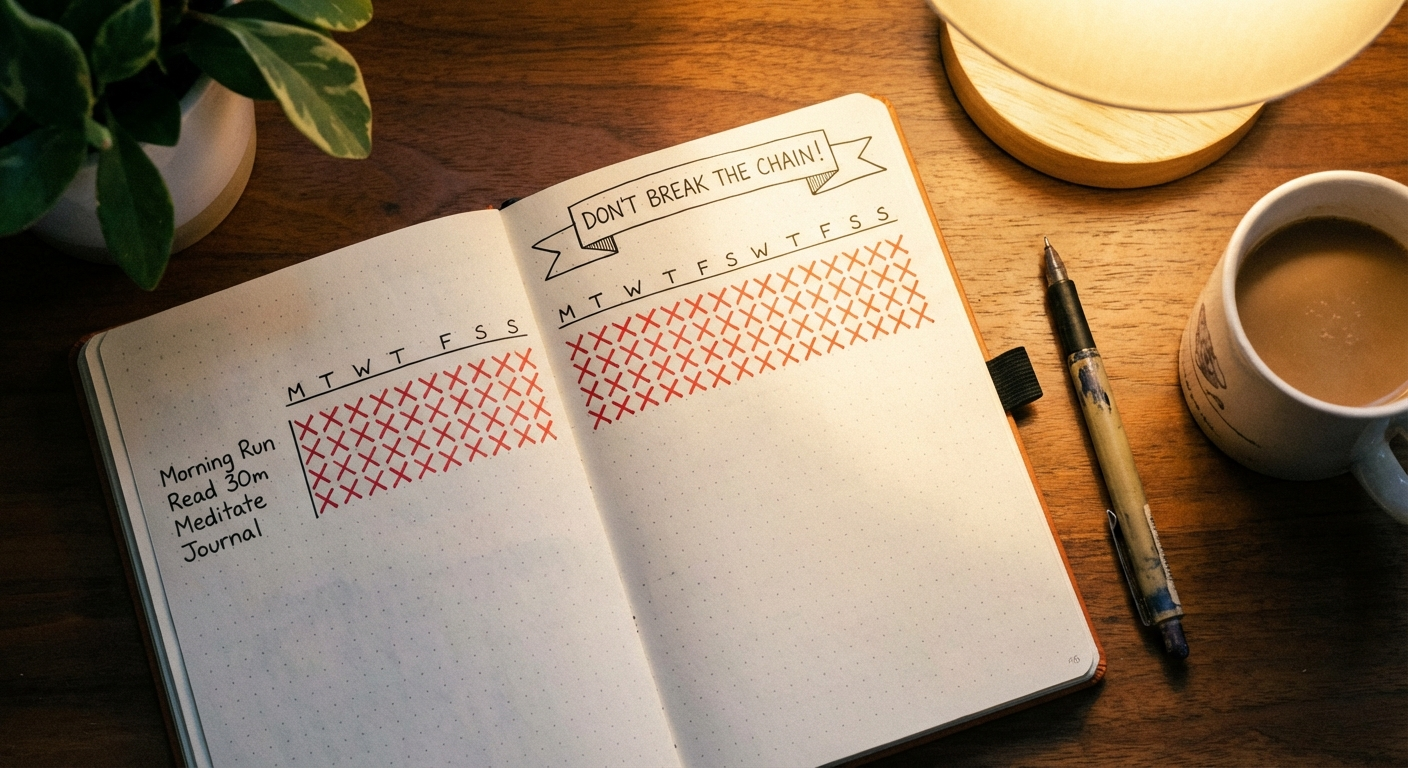
Jerry Seinfeld's famous "don't break the chain" method works because it leverages loss aversion — the psychological principle that losing a streak feels roughly twice as painful as the pleasure of building one. A visible habit tracker on your wall or phone makes your progress tangible and the cost of quitting visible.
3. Identity-Based Habits
Rather than focusing on outcomes ("I want to lose 20 pounds"), focus on identity ("I am a person who moves their body daily"). Research in self-determination theory suggests that behaviors aligned with identity are more intrinsically motivated and more durable. Each repetition becomes a vote for the person you are becoming.
4. Reward Substitution
For habits where the natural reward is delayed (exercise, healthy eating, saving money), create an immediate reward to bridge the gap. This aligns with behavioral psychology's principle of temporal discounting — we heavily favor immediate rewards over future ones. A small treat, a checkmark on your tracker, or a moment of self-congratulation all count.
5. Strategic Friction Management
Make good habits easy and bad habits hard. Dr. Wendy Wood's research found that even minor friction changes — like moving snacks from the counter to a high shelf — significantly altered behavior. Apply this principle in both directions: reduce every possible barrier to your desired habit and increase barriers to competing behaviors. For more on structuring your environment for success, check out how to organize your habit tracking system.
Best Habit Tracking Tools for 2026
Tracking your habits is not just satisfying — it is scientifically supported. Self-monitoring increases awareness and strengthens the feedback loop your brain needs to solidify new behaviors. Here are the most effective tools for your 21-day kickstart and beyond.
Habitica
Best for: Gamification lovers
Turns your habits into an RPG adventure. Complete habits to level up your character, earn gold, and unlock gear. Miss habits and your character takes damage. Research on gamification shows it increases engagement by 48 percent on average.
Price: Free (Premium $4.99/month)
Streaks App
Best for: Apple ecosystem users
Minimal, beautiful, and integrated with Apple Health. Tracks up to 24 habits with customizable schedules. The visual streak counter is a powerful loss-aversion trigger.
Price: $4.99 one-time
The Habit Tracker Journal by Clever Fox
Best for: Pen-and-paper people
A physical journal with structured layouts for daily, weekly, and monthly habit tracking. Research suggests that handwriting engages deeper cognitive processing than digital input, strengthening commitment.
Price: $24.99
Notion Habit Dashboard
Best for: Customization enthusiasts
Build your own tracking system with databases, templates, and automations. Ideal for people who want to track habits alongside goals, projects, and notes in one workspace.
Price: Free (Plus $8/month)
Loop Habit Tracker
Best for: Android users who want simplicity
Open-source, ad-free, and focused entirely on habit tracking. Includes detailed graphs and statistics to visualize your progress over time. The score algorithm rewards consistency over perfection.
Price: Free
Common Mistakes That Derail Habit Formation
Understanding why habits fail is just as important as knowing how to build them. These are the most common errors, backed by research on behavior change.
Relying on Motivation
Motivation is a terrible foundation for habits. It fluctuates with mood, energy, sleep, and stress. Dr. Wendy Wood's research shows that approximately 43 percent of daily behaviors are performed habitually — meaning without conscious motivation. The goal is to move your new behavior into that automatic category, not to sustain motivation indefinitely.
Starting Too Big
Ambition is the enemy of consistency in the early stages. When Stanford researcher BJ Fogg asked participants to start with "tiny habits" — behaviors taking 30 seconds or less — adherence rates were dramatically higher than for ambitious goals. You can always scale up after the behavior is established. You cannot scale something you have already quit.
Ignoring Context
Habits are deeply context-dependent. The same person who exercises every morning at home may completely abandon the routine while traveling. Research on "context-dependent repetition" shows that performing a habit in the same location, at the same time, after the same cue is critical during the formation phase. Consistency of context accelerates automaticity.
All-or-Nothing Thinking
Missing one day does not erase your progress. Lally's research confirmed this directly — occasional missed days had no measurable impact on the habit formation timeline. The danger is the psychological spiral: "I missed yesterday, so I've failed, so why bother?" This cognitive distortion, not the missed day itself, is what kills habits.
Not Tracking
What gets measured gets managed. People who track their habits have significantly higher success rates than those who rely on memory and intention alone. If you struggle with staying consistent with your sleep routine, tracking becomes even more critical because it reveals patterns you might otherwise miss.
What Happens After Day 21
Day 21 is a milestone, not a finish line. Here is what to expect as you continue building toward full automaticity.
Days 22–40: The maintenance phase. The habit is easier but not yet automatic. Continue with your cue-routine-reward loop and tracking. This is where many people get complacent and slowly drift away from the behavior.
Days 40–66: Approaching automaticity. For moderately complex habits, this is when the behavior starts to feel genuinely automatic. You may notice discomfort when you miss the habit — a reliable sign that the basal ganglia has taken over.
Days 66+: Consolidation and expansion. The habit is established. You can now use it as a foundation for habit stacking, building additional behaviors on top of your new automatic routine. This is how small habits compound into transformative lifestyle changes.
The 21-day framework is not wrong — it is just the beginning. Use it as your launchpad, not your destination. The science is clear: consistency beats intensity, systems beat motivation, and small beats ambitious. Start your 21-day kickstart today, track your progress, and trust the process. Your brain is already rewiring itself with every repetition.

Sources and Methodology
This article draws on peer-reviewed research in behavioral psychology and neuroscience. Key sources include:
- Lally, P., van Jaarsveld, C. H. M., Potts, H. W. W., & Wardle, J. (2010). "How are habits formed: Modelling habit formation in the real world." European Journal of Social Psychology, 40(6), 998–1009. The foundational study on habit formation timelines.
- Graybiel, A. M. (2008). "Habits, rituals, and the evaluative brain." Annual Review of Neuroscience, 31, 359–387. Key research on the basal ganglia's role in habit encoding.
- Wood, W., & Neal, D. T. (2007). "A new look at habits and the habit-goal interface." Psychological Review, 114(4), 843–863. Research on environmental cues and automatic behavior.
- Gollwitzer, P. M. (1999). "Implementation intentions: Strong effects of simple plans." American Psychologist, 54(7), 493–503. Evidence for if-then planning in behavior change.
- Fogg, B. J. (2019). Tiny Habits: The Small Changes That Change Everything. Stanford behavioral scientist's research on starting small.
- Milkman, K. L., Minson, J. A., & Volpp, K. G. M. (2014). "Holding the Hunger Games hostage at the gym: An evaluation of temptation bundling." Management Science, 60(2), 283–299. Research on pairing desired and required behaviors.
- Oettingen, G. (2014). Rethinking Positive Thinking: Inside the New Science of Motivation. Research on the WOOP mental contrasting method.
- Duhigg, C. (2012). The Power of Habit: Why We Do What We Do in Life and Business. Popularization of the cue-routine-reward habit loop based on MIT research.
Methodology: All claims about habit formation timelines, brain mechanisms, and behavior change strategies are grounded in published research. Where exact statistics are cited, the original study is referenced. General behavioral principles are attributed to the researchers who established them.
Frequently Asked Questions
Can you really form a habit in 21 days?
The 21-day myth originated from Dr. Maxwell Maltz's observations in the 1960s, but research from University College London found that habit formation takes an average of 66 days. However, simple habits like drinking a glass of water in the morning can solidify in as few as 18 days, while complex habits may take 254 days or more. Twenty-one days is an excellent kickstart period to establish the foundation of a new habit.
What is the fastest way to build a new habit?
The fastest method combines habit stacking (attaching new habits to existing routines), environment design (removing friction), and consistent repetition at the same time and place each day. Starting with a habit so small it takes less than two minutes removes willpower barriers and builds the neural pathways faster.
Why do most people fail at building new habits?
Most people fail because they rely on motivation instead of systems, set goals that are too ambitious, skip days during the critical first two weeks, and lack accountability. Research shows that missing a single day does not significantly impact long-term habit formation, but missing two consecutive days dramatically increases the chance of quitting entirely.
What happens in the brain when you form a habit?
During habit formation, activity shifts from the prefrontal cortex (conscious decision-making) to the basal ganglia (automatic processing). Repeated behavior creates stronger neural pathways through a process called long-term potentiation, and dopamine release patterns shift from the reward itself to the cue that triggers the habit.
Do habit tracking apps actually help?
Yes — research supports that habit tracking increases success rates. A study in Behavioral Science found that participants who tracked habits daily were significantly more likely to maintain them long-term. The visual record of streaks leverages loss aversion, making you less likely to break the chain.
What is the 2-minute rule for habits?
The 2-minute rule, popularized by James Clear, states that any new habit should take less than two minutes to complete when you first start. Want to read more? Start by reading one page. Want to exercise? Start by putting on your running shoes. This removes the activation energy barrier and helps the behavior become automatic before you scale up.