Guide
Why Your Habits Keep Failing (and How to Fix It)
By Habit Tracker Spot · Updated 2026-03-10
Most habits fail not because of laziness or lack of willpower, but because of predictable design flaws in how people set them up. Research from University College London shows that 66 days of consistent repetition is needed for automaticity — yet most people abandon new habits within 14 days. The fix is systematic: redesign your environment, shrink the behavior, track your consistency, and stop relying on motivation.
By James Mercer, Behavioral Psychology Researcher · Published March 23, 2026
Affiliate disclosure: This article contains affiliate links to products we genuinely recommend. If you purchase through our links, we may earn a small commission at no extra cost to you. This never influences our recommendations.

You started the year with a plan. Wake up at 6 AM. Meditate for 20 minutes. Hit the gym four times a week. Read for 30 minutes before bed. By February, every single one was gone.
You are not alone. Research from the University of Scranton found that only 19 percent of people who set New Year's resolutions actually keep them long-term. The fitness industry counts on this — gym memberships spike 12 percent in January and usage drops to baseline by March, according to data from the International Health, Racquet & Sportsclub Association.
But here is the part that nobody tells you: your habits are not failing because something is wrong with you. They are failing because you are making specific, identifiable mistakes in how you design and execute them. Every single one of these mistakes has a research-backed fix.
This article breaks down the seven most common reasons habits fail, the behavioral science behind each one, and a concrete action plan to fix every single failure point.
Table of Contents
- The Motivation Trap: Why Willpower Always Runs Out
- Setting Habits Too Big: The Ambition Paradox
- Missing the Environment Design Step
- No Tracking System: What Gets Measured Gets Done
- The All-or-Nothing Mindset That Kills Consistency
- Ignoring Identity: Why You Need to Become the Person First
- Lack of Accountability and Social Structure
- The Habit Repair Framework: A Step-by-Step Fix
- Best Tools for Building and Tracking Habits
- Frequently Asked Questions
- Sources & References
The Motivation Trap: Why Willpower Always Runs Out
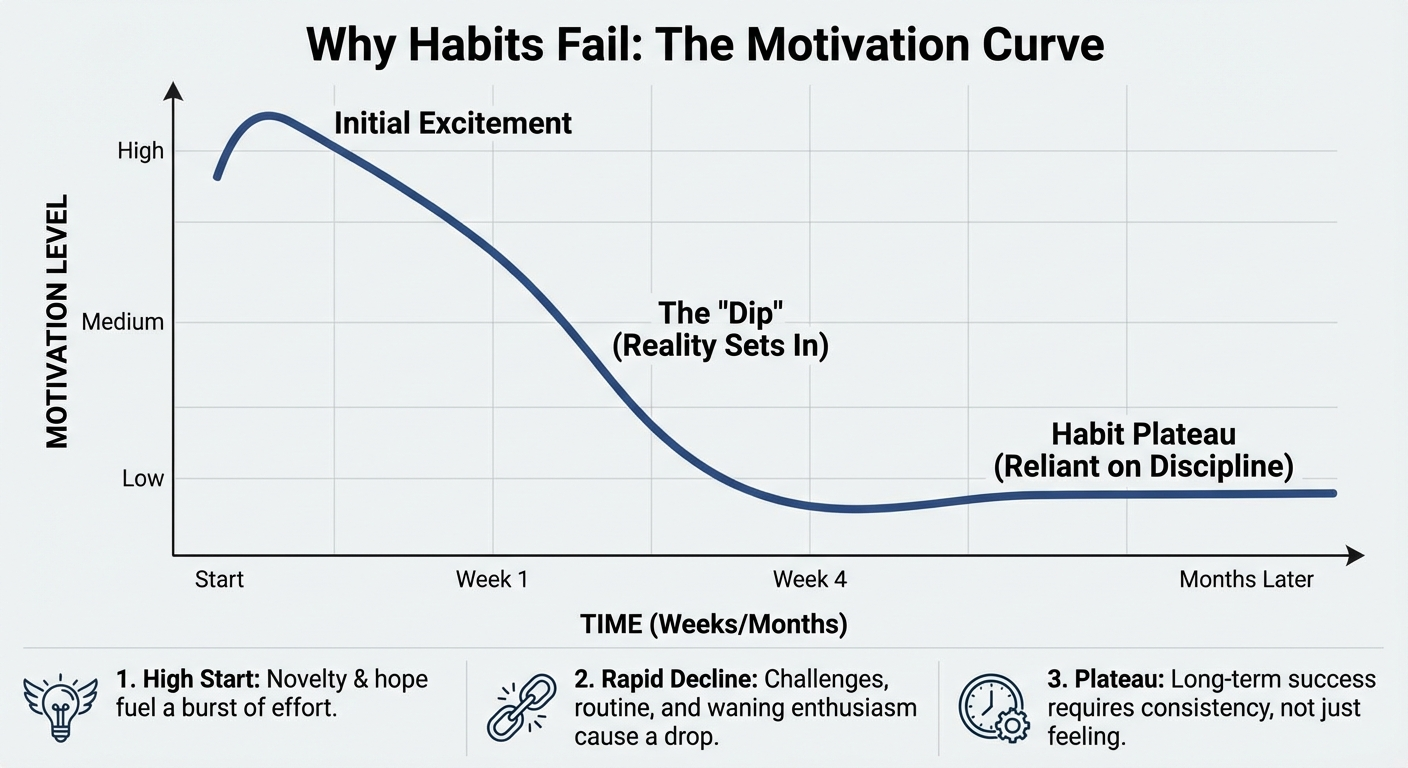
The number one reason habits fail is that people build them on motivation. Motivation is an emotion — it fluctuates with your sleep quality, stress levels, blood sugar, weather, and a thousand other variables you cannot control. Building a habit on motivation is like building a house on sand.
Dr. Roy Baumeister's ego depletion research at Florida State University demonstrated that self-control functions like a muscle: it fatigues with use. Every decision you make throughout the day — what to wear, what to eat, how to respond to that email, whether to bite your tongue in a meeting — draws from the same finite willpower reserve. By evening, the tank is empty. That is why your plan to go to the gym "after work" collapses every single time.
The Motivation-Action Fallacy
Most people believe the sequence is: Motivation → Action → Results. In reality, behavioral research shows the sequence is reversed: Action → Results → Motivation. You do not get motivated and then act. You act — often before you feel like it — and the results generate motivation to continue.
This is why the advice "just find your why" fails for most people. Your "why" does not get you to the gym on a cold Tuesday when you slept five hours and your boss yelled at you. A system does.
How to Fix It
Replace motivation with environmental design and scheduling. Instead of relying on feeling like doing your habit, make the habit the default:
- Schedule it: Put the habit in your calendar with a specific time and location. Research on implementation intentions by Dr. Peter Gollwitzer at NYU found that people who specify when and where they will perform a behavior are 2x to 3x more likely to follow through.
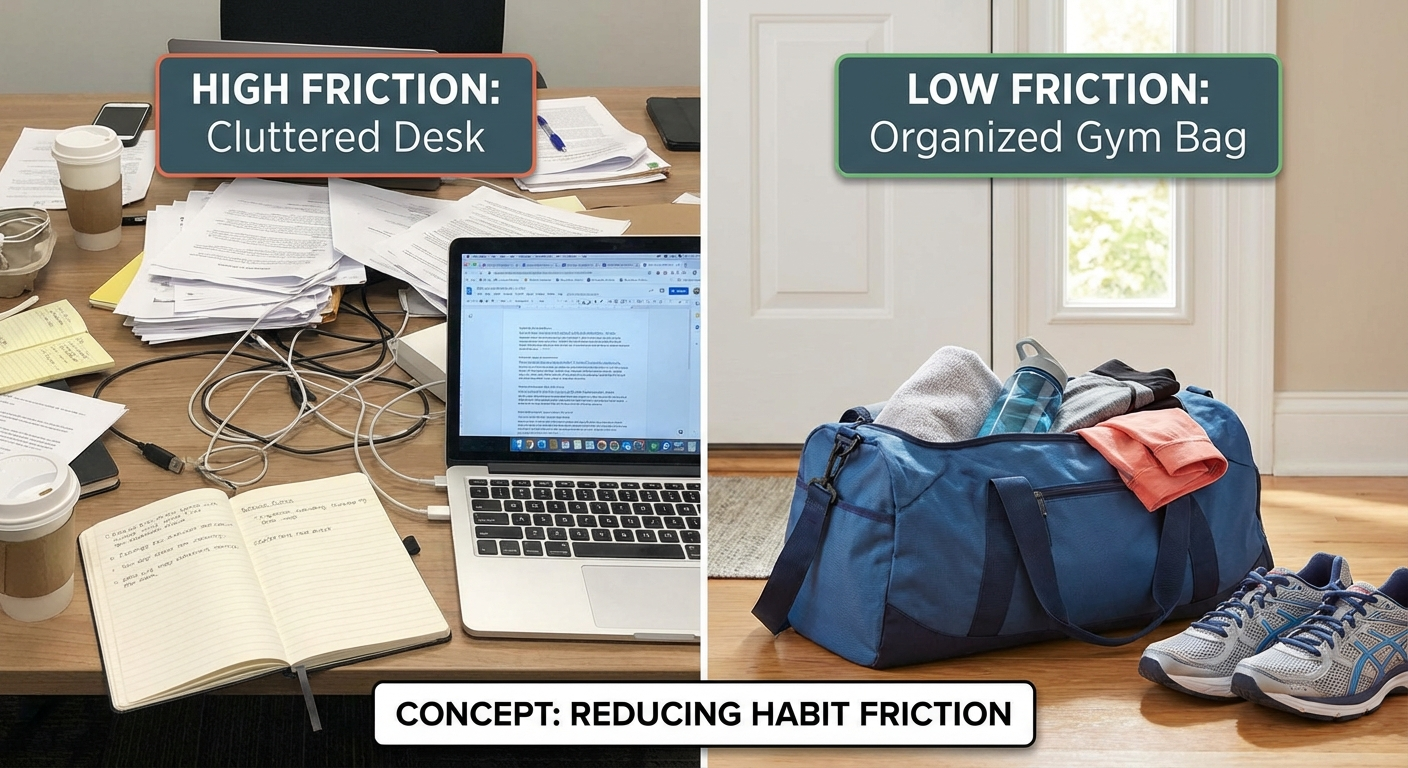
- Reduce friction: If you want to run in the morning, sleep in your running clothes. If you want to eat healthier, prep meals on Sunday. Every second of friction between you and the habit is a chance for your brain to talk you out of it.
- Use habit stacking: Attach the new habit to an existing automatic behavior. "After I pour my morning coffee, I will meditate for two minutes." Learn the full framework in our guide to habit stacking.
Setting Habits Too Big: The Ambition Paradox
The second most common failure point is ambition. When you are feeling motivated on day one, committing to "meditate for 30 minutes every morning" feels easy. On day eight, when the alarm goes off and you are exhausted, 30 minutes feels impossible. So you skip it entirely.
This is the ambition paradox: the bigger the habit you commit to, the more likely you are to fail. Not because big habits are bad, but because your brain perceives them as threats. Dr. BJ Fogg at Stanford calls this the "motivation wave" — you set ambitious goals at the peak of a motivation wave, then fail when the wave inevitably crashes.
The Two-Minute Rule
James Clear's two-minute rule states that any new habit should take less than two minutes to perform. Not because two-minute habits are the end goal, but because they eliminate the barrier to starting:
- "Read 30 pages" becomes "read one page"
- "Run 5 miles" becomes "put on running shoes"
- "Meditate for 20 minutes" becomes "sit on the cushion and take three breaths"
- "Write 1,000 words" becomes "write one sentence"
This is not lowering your standards. It is a behavioral design strategy grounded in BJ Fogg's Tiny Habits research at Stanford. The data shows that once you start a behavior — no matter how small — you typically continue beyond the minimum. The hardest part of any habit is crossing the starting line.
Scaling Up: The Progression Framework
Once your two-minute version is automatic (usually 2 to 3 weeks), increase by no more than 10 percent:
| Week | Meditation Habit | Running Habit |
|---|---|---|
| 1-2 | Sit and breathe for 2 minutes | Put on shoes, walk to the end of the driveway |
| 3-4 | 5-minute guided meditation | Walk for 10 minutes |
| 5-6 | 10-minute meditation | Jog for 10 minutes |
| 7-8 | 15-minute meditation | Jog for 15 minutes |
| 9+ | 20-minute meditation | Run for 20 minutes |
Missing the Environment Design Step
If you have to rely on remembering to do your habit, it will fail. Memory is unreliable, especially under stress. The most effective habit builders do not rely on memory or discipline — they redesign their environment so the right behavior becomes the path of least resistance.
Dr. Wendy Wood at the University of Southern California has spent three decades researching habit formation. Her work consistently shows that context — the physical and digital environment — is a stronger predictor of behavior than intention, motivation, or personality.
The Power of Visual Cues
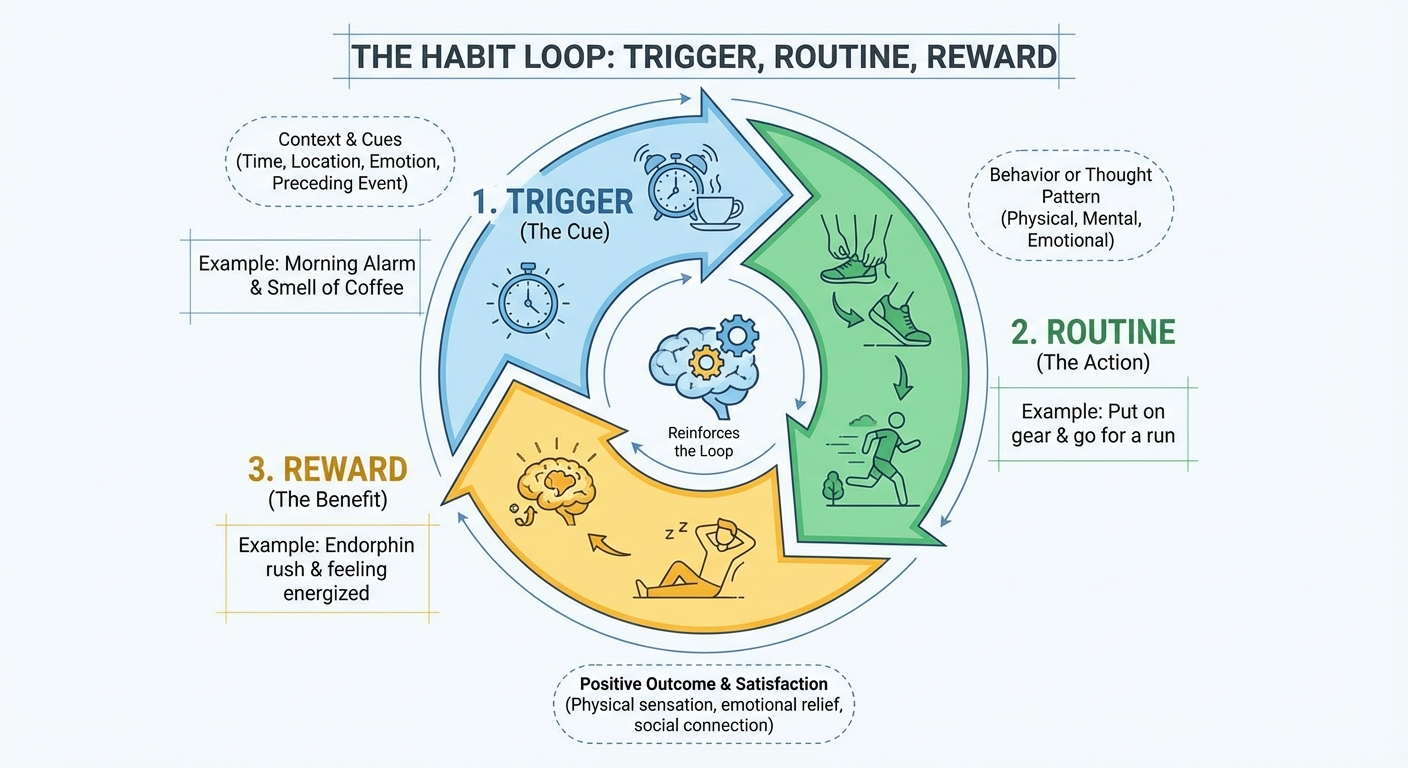
Your brain is constantly scanning the environment for cues that trigger behavior. If you want to build a reading habit, put the book on your pillow so you literally cannot get into bed without picking it up. If you want to drink more water, put a full water bottle on your desk every morning before you do anything else. If you want to practice guitar, put the guitar on a stand in the middle of your living room — not in a case in the closet.
The inverse is equally powerful for breaking bad habits. If you want to stop scrolling social media in bed, charge your phone in the kitchen. If you want to stop eating junk food, do not keep it in the house. Out of sight, out of mind is not just a saying — it is neuroscience.
Environment Design Checklist
Use this checklist to audit your environment for each habit you are trying to build:
- Is the cue visible? Can you see the trigger for your habit without looking for it?
- Is the tool accessible? Is everything you need within arm's reach, already set up?
- Is the friction removed? Have you eliminated every unnecessary step between you and the behavior?
- Are competing cues hidden? Have you removed visual triggers for behaviors that compete with your habit?
- Is the space dedicated? Do you have a specific location associated only with this habit?

If you have ADHD, environment design is even more critical because working memory deficits make it harder to remember habits that are not visually cued. Our ADHD daily planner guide covers environment design strategies specifically for the ADHD brain.
No Tracking System: What Gets Measured Gets Done
A 2016 meta-analysis published in Health Psychology Review examined 94 studies on behavior change techniques. The single most effective technique across all studies was self-monitoring — the act of tracking whether you performed the behavior.
Tracking works for three reasons:
- Visual accountability. Seeing a streak of check marks creates a psychological contract with yourself. Breaking the streak feels costly, which adds a layer of motivation that exists independently of how you feel on any given day.
- Data feedback loops. When you track, you can see patterns. Maybe you always skip your habit on Wednesdays because that is your busiest work day. That is actionable data you can use to restructure.
- Celebration triggers. BJ Fogg's research shows that positive emotion immediately after a behavior is the single most important factor in habit formation. Checking a box — seeing that green checkmark — generates a small dopamine hit that reinforces the neural pathway.
What to Track and How
You do not need to track everything. Track only the habits you are actively trying to build — usually 3 to 5 at most. More than that creates tracking fatigue, which leads to abandoning the system entirely.
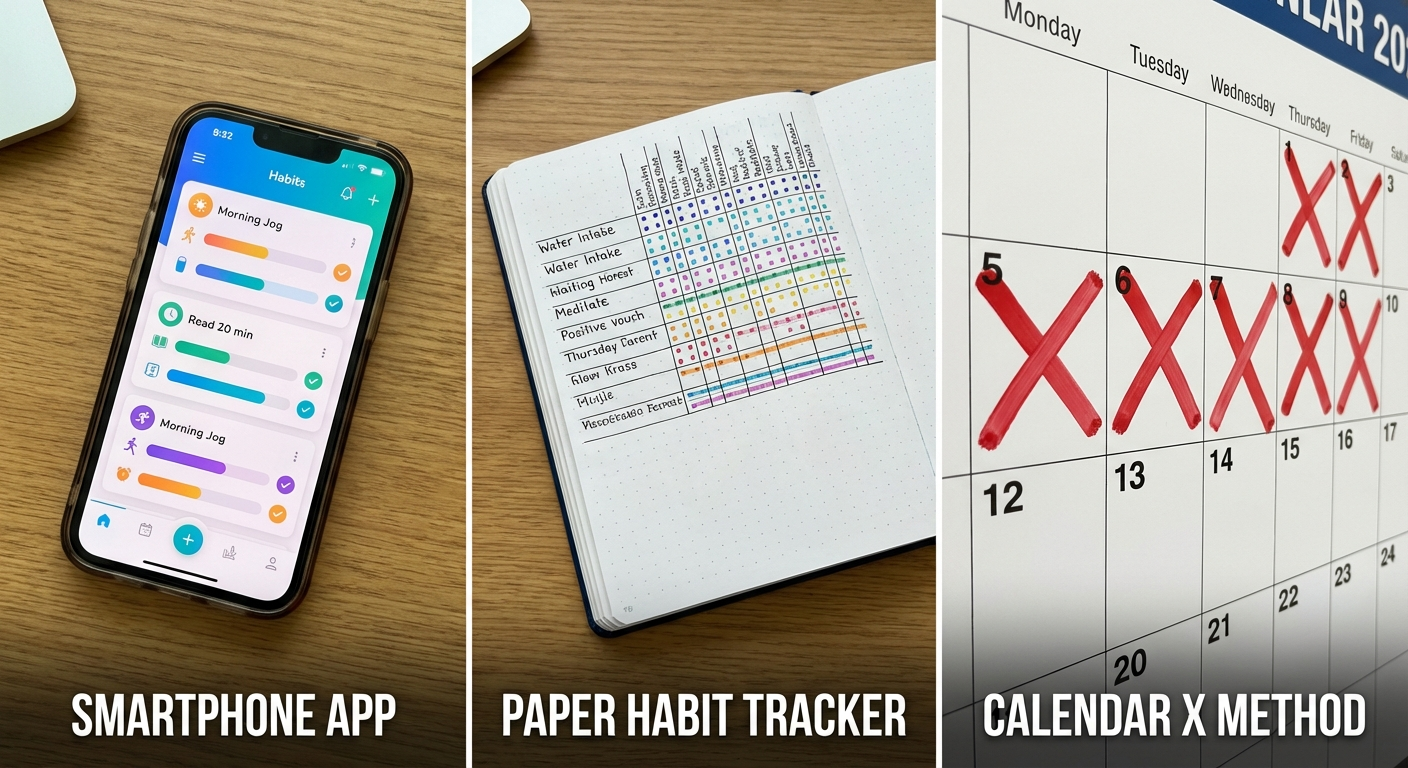
There are three tracking approaches, and the best one depends on your personality:
Digital trackers: Apps like Streaks, Habitica, or Atoms provide automatic reminders, visual streaks, and data analytics. Best for people who always have their phone and want data-driven feedback. See our full breakdown in best habit tracker apps for 2026.
Paper trackers: Physical journals like the Habit Nest Journal or Clever Fox Planner provide a tactile check-in experience. Best for people who are easily distracted by their phone or who find writing by hand more satisfying. Check our reviews of the best habit tracker journals.
Hybrid systems: Use a paper planner for daily planning and a digital app for streak tracking and reminders. This is what most behavioral researchers actually use themselves.
The All-or-Nothing Mindset That Kills Consistency
"I already missed Monday, so this week is ruined. I will start fresh next Monday."
This thought pattern — the all-or-nothing mindset — kills more habits than any other psychological trap. Researchers call it the "what-the-hell effect," formally known as the abstinence violation effect. One slip triggers the perception of total failure, which leads to complete abandonment.
The data tells a different story. A 2020 study from the University of Victoria analyzed habit formation data from over 1,000 participants and found that missing a single day had zero measurable impact on long-term habit formation. Missing two consecutive days reduced long-term success by 7 percent. Missing three or more consecutive days reduced success by 30 percent.
The takeaway is clear: one miss does not matter. Two misses are the danger zone.
The Never-Miss-Twice Rule
This is the single most important rule in habit building. You will miss days. Life happens — you get sick, you travel, your kid has a meltdown, your car breaks down. The goal is never perfection. The goal is never missing twice.
When you miss once:
- Acknowledge it without judgment
- Do not try to "make up for it" by doing double the next day
- Simply perform the habit at its normal level the next day
- If even that feels hard, scale it down to the two-minute version
Reframing Failure
Instead of "I failed at my habit," try "I am collecting data about my habit." Every miss is information:
- If you miss the same day each week, that is a scheduling problem, not a discipline problem
- If you miss whenever you are stressed, you need to scale the habit down to a stress-proof version
- If you miss whenever you travel, you need a travel-specific version of the habit
A person who does their habit four days out of seven, every single week, will be in a radically different place in a year than someone who does it perfectly for three weeks and then quits entirely.
Ignoring Identity: Why You Need to Become the Person First
Most people set habits based on outcomes: "I want to lose 20 pounds." "I want to read 50 books this year." "I want to run a marathon." These are fine goals, but they make terrible foundations for habit building because they are oriented toward a future result, not a present identity.
James Clear's identity-based habits framework flips the script. Instead of starting with what you want to achieve, start with who you want to become:
- "I want to lose 20 pounds" → "I am the type of person who moves their body every day"
- "I want to read 50 books" → "I am a reader"
- "I want to run a marathon" → "I am a runner"
This is not woo-woo affirmation stuff. It is grounded in self-determination theory, developed by Dr. Edward Deci and Dr. Richard Ryan at the University of Rochester. Their research shows that behaviors aligned with a person's self-concept are dramatically more likely to persist because they become intrinsically motivated rather than externally driven.
How Identity Shifts Work
Every time you perform a habit, you are casting a vote for the type of person you want to become. Each rep is evidence:
- Every page you read is a vote for "I am a reader"
- Every workout is a vote for "I am an athlete"
- Every morning meditation is a vote for "I am a calm, centered person"
- Every healthy meal is a vote for "I am someone who fuels their body well"
You do not need a unanimous vote. You need a majority. You just need enough evidence to believe the identity is real.

The Identity Habit Exercise
Grab a piece of paper and answer these three questions:
- What type of person do I want to become? (Not what do I want to achieve — who do I want to be?)
- What would that person do today? (Not this month, not this year — today.)
- What is the smallest version of that behavior I can do right now?
The answers to question three become your habits.
Lack of Accountability and Social Structure
Humans are social animals. We evolved in tribes where social accountability was baked into daily life. Today, most of us try to build habits in complete isolation — and the failure rate reflects it.
Research from the American Society of Training and Development found that people are 65 percent more likely to complete a goal after committing to another person. When they have a specific accountability appointment with that person, the probability increases to 95 percent.
Types of Accountability
1. Accountability partners. Pair up with someone working on a similar habit. Check in daily via text. Keep it simple: "Did you do the thing today? Yes / No." No judgment, no lectures, just data.
2. Public commitment. Telling people about your habit creates social pressure to follow through. Post your streak on social media. Tell your coworkers. The more people who know, the higher the social cost of quitting.
3. Habit communities. Online groups like Reddit's r/theXeffect, Habitica guilds, or the Atomic Habits community provide built-in accountability without requiring a single partner. You post your daily check-in and the community provides reinforcement.
4. Financial accountability. Apps like Beeminder and StickK let you put money on the line. If you do not complete your habit, you pay a penalty — either to a charity or an anti-charity (an organization you despise). Research shows financial stakes increase follow-through rates by 3x.
5. Coaching and professional support. If you have tried self-directed habit building repeatedly and it has not worked, a behavioral coach or therapist can identify blind spots. This is especially important for people with ADHD, where executive function challenges require additional support. Our guide to ADHD morning routines covers structured accountability systems designed for the ADHD brain.
For broader habit building strategies for ADHD, combining accountability with environment design tends to produce the strongest results.

The Habit Repair Framework: A Step-by-Step Fix
Now that you understand why habits fail, here is the framework for fixing them. This is a systematic process you can apply to any habit that is currently failing or any new habit you want to build.
Step 1: Diagnose the Failure Point
Look at your failed habit and identify which of the seven failure points is the primary cause:
| Failure Point | Symptom | Fix |
|---|---|---|
| Motivation trap | "I just don't feel like it" | Environmental design + scheduling |
| Too ambitious | "It takes too long so I skip it" | Two-minute rule |
| No cues | "I keep forgetting" | Visual cues + habit stacking |
| No tracking | "I don't know if I'm making progress" | Habit tracker app or journal |
| All-or-nothing | "I missed a day so I quit" | Never-miss-twice rule |
| No identity | "I'm not a [X] person" | Identity-based habit exercise |
| No accountability | "Nobody knows or cares" | Accountability partner or community |
Step 2: Apply the Fix
Do not try to fix all seven at once. Identify the primary failure point and address that single issue. Most habits fail for one or two core reasons, not all seven.
Step 3: Run the Experiment for 30 Days
Give the fix 30 days before evaluating. Track daily. At the end of 30 days, look at the data:
- 80%+ completion rate: The fix is working. Maintain the system and consider scaling up the habit by 10 percent.
- 50-79% completion rate: The fix is partially working. Look for patterns in the days you missed and address the secondary failure point.
- Below 50% completion rate: The primary failure point was misdiagnosed. Go back to step one and try a different diagnosis.
Step 4: Stack and Scale
Once one habit is stable at 80 percent or above for 30 consecutive days, you can add a second habit. Stack it onto the first one using the habit stacking formula: "After I [established habit], I will [new habit]."
Never try to build more than two new habits simultaneously. Your willpower budget and attention capacity cannot handle it.

Best Tools for Building and Tracking Habits
The right tools can make the difference between a habit that sticks and one that fades. Here are our top picks across apps, books, and journals — each addressing different failure points covered in this article.
Atomic Habits by James Clear
Best for: Identity-based habit building
The definitive guide to understanding why habits fail and how to fix them using the Four Laws of Behavior Change. Covers every failure point in this article with actionable frameworks.
Format: Paperback / Kindle / Audiobook Rating: 9.5/10
Tiny Habits by BJ Fogg
Best for: Fixing the "too ambitious" failure point
Stanford behavioral scientist BJ Fogg's system for starting absurdly small and scaling up. The two-minute rule, celebration technique, and anchor habits all originate from his research.
Format: Paperback / Kindle / Audiobook Rating: 9.2/10
Streaks App
Best for: Digital streak tracking (iOS)
The best habit tracker app for visual accountability. Limits you to 12 habits (preventing tracking fatigue), uses Apple Health integration, and provides a clean daily interface that takes under 10 seconds to complete.
Price: $4.99 (one-time purchase) Rating: 9.4/10
Clever Fox Habit Tracker Journal
Best for: Paper-based tracking with structure
A dedicated habit tracking journal with 90-day tracking spreads, weekly reflection prompts, and goal-setting frameworks. Excellent for people who want tactile accountability without phone distractions.
Format: Hardcover Journal Rating: 8.8/10
Habitica
Best for: Gamified accountability
Turns your habits into an RPG game. Completing habits levels up your character and earns rewards. Missing habits damages your health. The social guild feature provides built-in community accountability.
Price: Free / $4.99 per month premium Rating: 9.1/10
The Habit Nest Morning Sidekick Journal
Best for: Fixing the morning routine failure point
A 66-day guided morning routine journal based on the science of habit formation. Each day includes a reflection prompt, habit check-in, and motivational insight. Structured specifically around the 66-day automaticity timeline.
Format: Hardcover Journal Rating: 8.7/10
For a comprehensive breakdown of all the top tracking apps, see our full best habit tracker apps for 2026 guide, where we tested 30+ apps over 90 days.
Frequently Asked Questions
Why do most habits fail within the first two weeks?
Most habits fail in the first two weeks because people rely on motivation, which depletes rapidly. Research from University College London shows habit formation requires an average of 66 days. During the first 14 days, the behavior has not created strong enough neural pathways to feel automatic, so any disruption in motivation, schedule, or environment causes collapse. The solution is to design systems that bypass motivation entirely — use environmental cues, habit stacking, and accountability tools.
How long does it actually take to form a habit?
According to Dr. Phillippa Lally's 2009 study at University College London, published in the European Journal of Social Psychology, it takes an average of 66 days for a new behavior to become automatic. The range was 18 to 254 days depending on habit complexity. Simple behaviors like drinking water after breakfast form faster; complex behaviors like running for 30 minutes take much longer.
Is it true that it takes 21 days to build a habit?
No. The 21-day myth originated from Dr. Maxwell Maltz, a plastic surgeon who observed patients took about 21 days to adjust to their new appearance. This observation was misinterpreted and popularized as a universal habit formation rule. Peer-reviewed research consistently shows habit formation takes 66 days on average — more than three times longer. Read our full exploration in how to build a habit in 21 days (and why it takes longer).
What is the best way to restart a habit after falling off track?
Use the never-miss-twice rule: never skip the same habit two consecutive days. When you do miss, scale the habit down to its smallest version — if you missed a 30-minute workout, do 5 pushups instead. Research shows maintaining the behavioral pattern matters more than intensity. Restarting with a tiny version preserves the neural pathway and prevents the shame spiral that leads to complete abandonment.
Do habit tracker apps actually help people stick to habits?
Yes. A meta-analysis in Health Psychology Review found self-monitoring was the most effective behavior change technique across 94 studies. Habit tracker apps add visual accountability, streak motivation, and reminder systems that reduce the cognitive load of remembering the habit. The key is low friction — daily check-ins should take under 30 seconds.
Why does willpower fail for habit building?
Willpower functions like a battery with limited charge, a concept called ego depletion. Dr. Roy Baumeister's research at Florida State University showed self-control is finite and depletes with every decision throughout the day. By the time you need willpower for an evening habit, the tank is often empty. Successful habit builders design systems that bypass willpower entirely through environmental cues, scheduling, and automation.
Sources & References
-
Lally, P., van Jaarsveld, C.H.M., Potts, H.W.W., & Wardle, J. (2010). "How are habits formed: Modelling habit formation in the real world." European Journal of Social Psychology, 40(6), 998–1009.
-
Baumeister, R.F., & Tierney, J. (2011). Willpower: Rediscovering the Greatest Human Strength. Penguin Press.
-
Fogg, B.J. (2020). Tiny Habits: The Small Changes That Change Everything. Houghton Mifflin Harcourt.
-
Wood, W., & Neal, D.T. (2007). "A new look at habits and the habit-goal interface." Psychological Review, 114(4), 843–863.
-
Gollwitzer, P.M. (1999). "Implementation intentions: Strong effects of simple plans." American Psychologist, 54(7), 493–503.
-
Michie, S., Abraham, C., Whittington, C., McAteer, J., & Gupta, S. (2009). "Effective techniques in healthy eating and physical activity interventions: A meta-regression." Health Psychology, 28(6), 690–701.
-
Clear, J. (2018). Atomic Habits: An Easy & Proven Way to Build Good Habits & Break Bad Ones. Avery Publishing.
About the Author
James Mercer is a behavioral psychology researcher specializing in habit formation, self-regulation, and long-term behavior change. His work focuses on translating academic research into practical frameworks that people can apply in their daily lives. James has reviewed over 200 published studies on habit formation and has been building evidence-based habit systems for over a decade. He writes for Habit Tracker Spot to help readers understand the science behind why habits succeed or fail — and what to do about it.
Last updated March 23, 2026. Habit Tracker Spot independently researches and evaluates all recommended products and resources. For more on how we approach our recommendations, see our editorial guidelines.